The Importance of the Church of St. Saviour
The view that the ruins discovered near İncili Köşk belong to the Palace of Mangana, rather than to the Palace of the Bucoleon, can be supported by strong and logical evidence. The key to this identification lies in the firmly established position of the Church of the Holy Saviour, which stood at İncili Köşk.
Once the location of this church is accepted, the surrounding buildings can be placed with much greater certainty. The Church of the Holy Saviour thus serves as a crucial fixed point for understanding the layout of this part of Byzantine Constantinople Evidence Before and After the Turkish Conquest.
Relationship Between the Palace and the Church of St. George Mangana
Evidence from Historical Sources
In the first place, historical writers agree that the Palace of Mangana stood very close to the Church of St. George at the Mangana. Indeed, the connection between the palace and the church was so close that when Emperor Isaac Angelus destroyed the palace in order to reuse its materials for buildings of his own, the act was regarded as a form of sacrilege against the property of St. George, the great military saint associated with the monastery.
We have already shown that the Church of St. George Mangana lay a short distance to the west of the Church of the Holy Saviour, and therefore close to the site of İncili Köşk. If the palace stood near this church, as the sources clearly state, then any large palace remains found in the immediate vicinity of İncili Köşk must logically belong to the Palace of Mangana.
Agreement with Archaeological Evidence
The Ruins Near İncili Köşk
This conclusion fits well with the archaeological discoveries made during the construction of the Roumelian railway. The remains described by Dr. Paspates—including massive walls, marble columns, and decorated capitals—are exactly what one would expect from an imperial residence such as the Palace of Mangana Coastal Bulgaria Tours.
Although Dr. Paspates suggested that the animal heads on the capitals represented lions and bulls, and therefore pointed to the Palace of the Bucoleon, this interpretation was not universally accepted. As Dr. Mordtmann observed, this explanation was not admitted by Paspates’ critics, and cannot be regarded as decisive evidence.
The Meaning of the Name “Mangana”
Confirmation from Topography
Further support for this identification comes from the fact that the Mangana, from which the palace took its name, was itself located in this district. Historical texts consistently place the Mangana complex—including workshops and military facilities—along this part of the eastern shore. It is therefore entirely natural that the palace known as the Palace of Mangana should also have stood here.
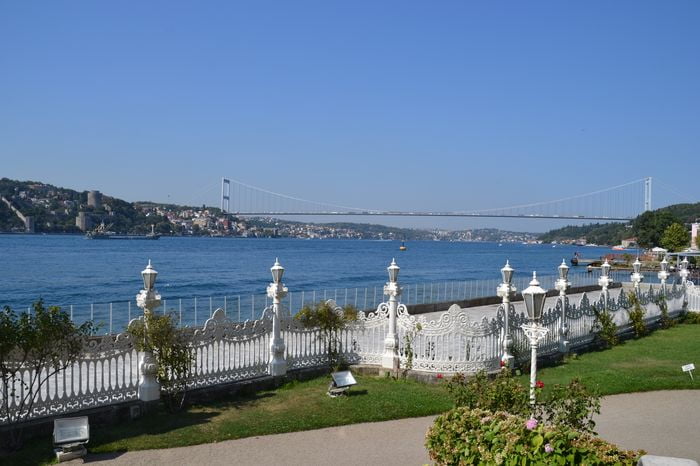
In addition, medieval writers note that the Palace of Mangana was famous for its cool and refreshing air. This description perfectly suits the position of İncili Köşk, which is exposed to the north winds blowing down the Bosporus from the Black Sea. Such a climate would have made the site especially pleasant as an imperial residence.
The Church of St. Lazarus
Its Approximate Location
The identification of the Palace of Mangana also helps to determine the position of the Church of St. Lazarus. From the order in which the Deacon Zosimus lists the churches he visited between Hagia Sophia and St. George Mangana, it is clear that the Church of St. Lazarus stood to the south of the Church of the Holy Saviour.
This places the church somewhere between İncili Köşk and the Seraglio Lighthouse, along the shore of the Sea of Marmora. Although the exact spot cannot be fixed with certainty, its general position can be determined with reasonable confidence.
Historical Importance of the Identification
This identification is especially important because near the Church of St. Lazarus stood a tier of stone seats known as the Topoi. These seats marked the southern extremity of the walls of ancient Byzantium along the Sea of Marmora. By locating the church, we also gain valuable insight into the earliest defensive limits of the city.
In conclusion, the combined evidence from historical texts, archaeological remains, and topographical features strongly supports the view that the ruins near İncili Köşk belong to the Palace of Mangana. This identification not only resolves a long-standing scholarly debate, but also helps clarify the arrangement of churches, palaces, and fortifications along the eastern shore of Byzantine Constantinople.